
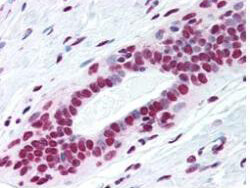
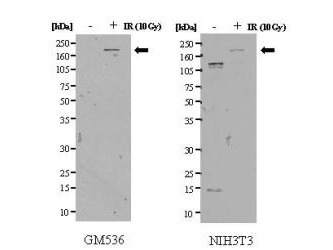
SMC1 phospho S957 Antibody
Mouse Monoclonal 5D11.G5 IgG1 kappa
$50.00 to US & $70.00 to Canada for most products. Final costs are calculated at checkout.
Background
Structural maintenance of chromosomes (SMC) proteins play important roles in sister chromatid cohesion, chromosome condensation, sex-chromosome dosage compensation, and DNA recombination and repair (DNA damage). Protein complexes containing heterodimers of the SMC1 and SMC3 proteins have been implicated specifically in both sister chromatid cohesion and DNA recombination. ATM, a protein kinase belonging to the phosphatidylinositol 3-kinase family that regulates cell cycle checkpoints and DNA recombination and repair, phosphorylates SMC1 protein after ionizing irradiation. ATM protein kinase phosphorylates SMC1 on serines 957 and 966 in vitro and in vivo, and expression of an SMC1 protein mutated at these phosphorylation sites abrogates the ionizing irradiation-induced S phase cell cycle checkpoint. Optimal phosphorylation of these sites in SMC1 after ionizing irradiation also requires the presence of the ATM protein kinase substrates NBS1 and BRCA1. These same sites in SMC1 are phosphorylated after treatment with UV irradiation or hydroxyurea in an ATM-independent manner, thus demonstrating that another kinase must be involved in responses to these cellular stresses. Yeast containing hypomorphic mutations in SMC1 and human cells overexpressing SMC1 mutated at both of these phosphorylation sites exhibit decreased survival following ionizing irradiation. These results demonstrate that SMC1 participates in cellular responses to DNA damage and link SMC1 to the ATM protein kinase signal transduction pathway.
Product Details
Target Details
Application Details
Formulation
Shipping & Handling
This product is for research use only and is not intended for therapeutic or diagnostic applications. Please contact a technical service representative for more information. All products of animal origin manufactured by Rockland Immunochemicals are derived from starting materials of North American origin. Collection was performed in United States Department of Agriculture (USDA) inspected facilities and all materials have been inspected and certified to be free of disease and suitable for exportation. All properties listed are typical characteristics and are not specifications. All suggestions and data are offered in good faith but without guarantee as conditions and methods of use of our products are beyond our control. All claims must be made within 30 days following the date of delivery. The prospective user must determine the suitability of our materials before adopting them on a commercial scale. Suggested uses of our products are not recommendations to use our products in violation of any patent or as a license under any patent of Rockland Immunochemicals, Inc. If you require a commercial license to use this material and do not have one, then return this material, unopened to: Rockland Inc., P.O. BOX 5199, Limerick, Pennsylvania, USA.