You may also want to consider these related products.
Recombinant Green Fluorescent Protein (GFP) Control Protein - 000-001-215
Anti-GFP (MOUSE) Monoclonal Antibody DyLight™ 488 Conjugated - 200-341-215
Anti-GFP (MOUSE) Monoclonal Antibody DyLight™ 800 Conjugated - 200-345-215
Anti-GFP (GOAT) Antibody IRDye® 800 Conjugated Min X Hu Ms and Rt Serum Proteins - 600-132-215
GFP and Epitopes  >  Antibodies to GFP and Antibodies to RFP
 

GFP Antibody

Rabbit Polyclonal
Code

600-401-215
Size

100 µg
Price

$190.00
Availability

Ships next business day.
Order Offline:
Phone: 800.656.7625
E-mail: orders@rockland-inc.com
Fax: 610.367.7825
Bulk Orders:
Call or E-mail Us For Information
Fill out our Contact Form
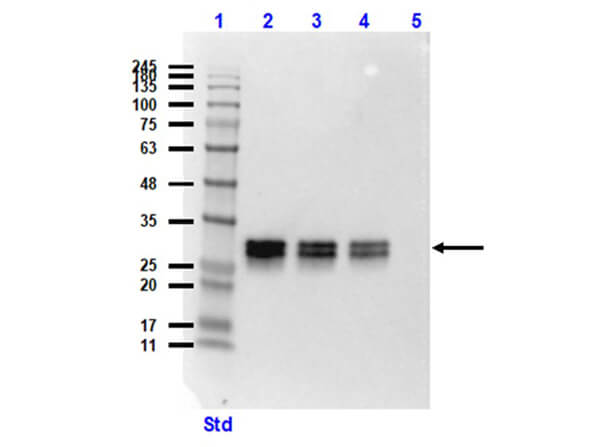
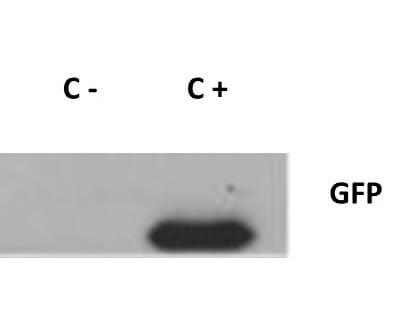
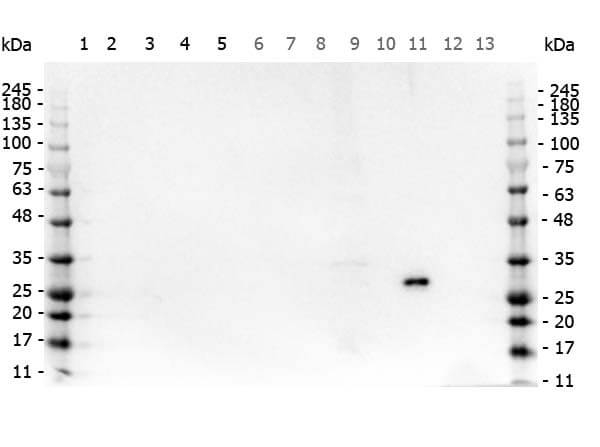
Western Blot of Rabbit anti-GFP antibody.  
Lane 1:  293FT cells transfected with CDK4 dominant negative (C-).
Lane 2:  293FT cells poitive control (C+).
Load:  25 µg per lane.
Primary antibody:  GFP antibody at 1:400 for overnight at 4°C.
Secondary antibody:  IRDye800™ rabbit secondary antibody at 1:10,000 for 45 min at RT.
Block:  5% BLOTTO overnight at 4°C.
Predicted/Observed size:  27 kDa for GFP.
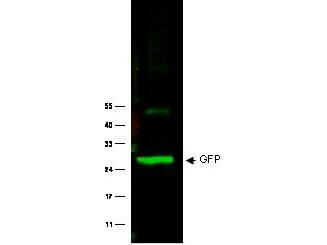
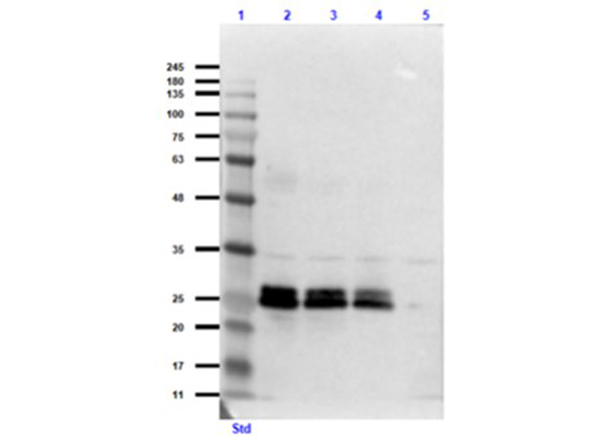
Western Blot of Rabbit anti-GFP antibody.  
Lane 1:  Wild type GFP (0.1 µg) was used to spike HeLa whole cell lysate.  
Lane 2:  none.  
Load:  30 µg per lane.
Primary antibody:  GFP antibody at 1:1000 for overnight at 4°C.
Secondary antibody:  IRDye800™  Goat-a-Rabbit IgG [H&L] MX10 (611-132-122) at 1:10,000 for 45 min at RT.
Block:  5% BLOTTO in PBS overnight at 4°C.
Predicted/Observed size: 27 kDa  for epitope tag GFP. 
Other band(s): none.
Shipping & Handling Fees Apply.

Shipping:
$85.00 to United States
Handling:
$45.00
Synonyms: GFP, Green Fluorescent Protein, GFP antibody, Green Fluorescent Protein antibody, EGFP, enhanced Green Fluorescent Protein, Aequorea victoria, Jellyfish.

GFP Antibody Properties

Description
Anti-GFP (RABBIT) Antibody - 600-401-215
Host
Rabbit
Known Cross Reactivity
wt and all variants such as rGFP, eGFP, S65T-GFP, RS-GFP, YFP and EGFP
Clonality
Polyclonal
Application
ELISA : 1:20,000 - 1:120,000
Western Blot : 1:500 - 1:5,000
Immunohistochemistry: 1:200 - 1:3,000
Other Dilution: User Optimized
Epitope Tag Type
GFP
Physical State
Liquid (sterile filtered)
Shipping condition
Dry Ice
Format
IgG
Label
Concentration
1.0 mg/mL by UV absorbance at 280 nm
Buffer
0.02 M Potassium Phosphate, 0.15 M Sodium Chloride, pH 7.2
Preservative
0.01% (w/v) Sodium Azide
Stabilizer
None
Download CofA
Lot#  

GFP Antibody Description

Background
Green fluorescent protein is a 27 kDa protein produced from the jellyfish Aequorea victoria, which emits green light (emission peak at a wavelength of 509nm) when excited by blue light. GFP is an important tool in cell biology research. GFP is widely used enabling researchers to visualize and localize GFP-tagged proteins within living cells without the need for chemical staining. GFP Antibody is ideal for Cell Biology, Neuroscience and Cancer research.
Immunogen
The immunogen is a Green Fluorescent Protein (GFP) fusion protein corresponding to the full length amino acid sequence (246aa) derived from the jellyfish Aequorea victoria.
Immunogen Type
Recombinant Protein
Storage Condition
Store Anti-GFP Antibody at -20° C prior to opening. Aliquot contents and freeze at -20° C or below for extended storage. Avoid cycles of freezing and thawing. Centrifuge product if not completely clear after standing at room temperature. GFP antibody is stable for several weeks at 4° C as an undiluted liquid. Dilute only prior to immediate use.
Application Note
Anti-GFP antibody is designed to detect GFP and its variants. GFP antibody can be used to detect GFP by ELISA (sandwich or capture) for the direct binding of antigen and recognizes wild type, recombinant and enhanced forms of GFP. Biotin conjugated polyclonal anti-GFP used in a sandwich ELISA is well suited to titrate GFP in solution using this antibody in combination with Rockland's monoclonal anti-GFP (600-301-215) using either form of the antibody as the capture or detection antibodies. However, use the monoclonal form only for the detection of wild type or recombinant GFP as this form does not sufficiently detect 'enhanced' GFP. The detection antibody is typically conjugated to biotin and subsequently reacted with streptavidin conjugated HRP (code # S000-03). Fluorochrome conjugated polyclonal anti-GFP can be used to detect GFP by immunofluorescence microscopy in prokaryotic (E.coli) and eukaryotic (CHO cells) expression systems and can detect GFP containing inserts. Significant amplification of signal is achieved using fluorochrome conjugated polyclonal anti-GFP relative to the fluorescence of GFP alone. For immunoblotting use either alkaline phosphatase or peroxidase conjugated polyclonal anti-GFP to detect GFP or GFP containing proteins on western blots. Optimal titers for applications should be determined by the researcher.
Purity/Specifity
Anti-GFP antibody was prepared from monospecific antiserum by immunoaffinity chromatography using Green Fluorescent Protein (Aequorea victoria) coupled to agarose beads followed by solid phase adsorption(s) to remove any unwanted reactivities.   Assay by immunoelectrophoresis resulted in a single precipitin arc against anti-Rabbit Serum and purified and partially purified Green Fluorescent Protein (Aequorea victoria).  No reaction was observed against Human, Mouse or Rat serum proteins.
Disclaimer Note-General
This product is for research use only and is not intended for therapeutic or diagnostic applications. Please contact a technical service representative for more information. All products of animal origin manufactured by Rockland Immunochemicals are derived from starting materials of North American origin. Collection was performed in United States Department of Agriculture (USDA) inspected facilities and all materials have been inspected and certified to be free of disease and suitable for exportation. All properties listed are typical characteristics and are not specifications. All suggestions and data are offered in good faith but without guarantee as conditions and methods of use of our products are beyond our control. All claims must be made within 30 days following the date of delivery. The prospective user must determine the suitability of our materials before adopting them on a commercial scale. Suggested uses of our products are not recommendations to use our products in violation of any patent or as a license under any patent of Rockland Immunochemicals, Inc. If you require a commercial license to use this material and do not have one, then return this material, unopened to: Rockland Inc., P.O. BOX 326, Gilbertsville, Pennsylvania, USA.
General Reference
Rizzolio F, Lucchetti C, Caligiuri I, Marchesi I, Caputo M, Klein-Szanto AJ, Bagella L, Castronovo M, Giordano A. (2012) Retinoblastoma tumor-suppressor protein phosphorylation and inactivation depend on direct interaction with Pin1. Cell Death and Differentiation 1-10. Nature
Specific Reference
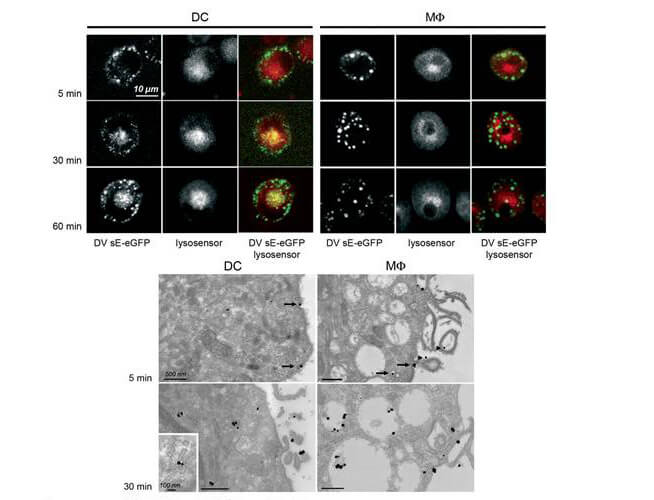
Jin, H. and Zangar, R. C. 2012. High-Throughput, Multiplexed Analysis of 3-Nitrotyrosine in Individual Proteins. Current Protocols in Toxicology. 51:17.15.1–17.15.16. Kwan W-H, Navarro-Sanchez E, Dumortier H, et al. Dermal-type macrophages expressing CD209/DC-SIGN show inherent resistance to dengue virus growth. PLoS Negl Trop Dis. 2008;2(10):e311. Papadopoulos C, Arato K, Lilienthal E, et al. Splice variants of the dual specificity tyrosine phosphorylation-regulated kinase 4 (DYRK4) differ in their subcellular localization and catalytic activity. J. Biol. Chem. 2011 Feb 18;286(7):5494–5505. Rizzolio F, Lucchetti C, Caligiuri I, et al. Retinoblastoma tumor-suppressor protein phosphorylation and inactivation depend on direct interaction with Pin1. Cell Death and Differentiation. 2012 Feb 10; Schmidt FI, Bleck CKE, Helenius A, Mercer J. Vaccinia extracellular virions enter cells by macropinocytosis and acid-activated membrane rupture. EMBO J. 2011 Aug 31;30(17):3647–3661. Torres J, Funk HM, Zegers MMP, ter Beest MBA. The syntaxin 4 N terminus regulates its basolateral targeting by munc18c-dependent and -independent mechanisms. J. Biol. Chem. 2011 Mar 25;286(12):10834–10846. Venters SJ, Cuenca PD, Hyer J. Retinal and anterior eye compartments derive from a common progenitor pool in the avian optic cup. Mol. Vis. 2011;17:3347–3363.
There are no reviews for this product. Log in to submit your own review.

AMCA Conjugates
Antigen Retrieval Methods
Azide Removal by Dialysis
Beta Galactosidase Conjugates
Biotin Binding Assay (HABA)
Biotin Conjugates
Cell Lysates Protocol
CyDye™ Conjugates
DyLight™ Antibody Conjugate Properties
DyLight™ Antibody Spectra
ELISA
ELISA to Quantify Collagen
Extended Conjugate Information Sheet
Fab Fragment Monovalent Antibodies
FACS / Flow Cytometry Analysis
Fluorescein Conjugates
Gel Shift Assay
General Antibody Information
Histone Immunoblotting
Immunoblotting
Immunocytochemistry
Immunofluorescence Microscopy
Immunofluorescence Microscopy - Assay Formats
Immunofluorescence Microscopy - ATTO-TEC
Immunofluorescence Microscopy - CyDye®
Immunofluorescence Microscopy - DyLight™
Immunofluorescence Microscopy - Fluorescent Labels
Immunofluorescence Microscopy - IRDye®
Immunofluorescence Microscopy - long
Immunofluorescence Microscopy - Microscope Types
Immunofluorescence Microscopy - Other Conjugates
Immunofluorescence Microscopy Protocol
Immunohistochemistry
Immunoprecipitation
Nuclear/Cytoplasmic Extract Isolation
Peroxidase & Alkaline Phosphatase
Phosphorylated State Proteins
Phosphorylated State Proteins - AKTs
Phosphorylated State Proteins - Long
Phosphorylated State Proteins - Pathways
Phosphorylated State Proteins - Phospho Specific
Phosphorylated State Proteins - Tailored Phosphorylated Target
Phosphorylated State Proteins - Western Blot
Phycoerythrin Conjugates
Protein A / Protein G Binding Reactivities
Recommended Dilutions
Rhodamine & Texas Red™
SDS-PAGE
Staining Paraffin Sections by PAP Procedure
USDA & Material Safety Notice
Western Blot - Buffers
Western Blot - Long
Western Blot - Preassembled Kits
Western Blot - Primary Antibody Reagents
Western Blot - Secondary Antibody Reagents
Western Blot - Substrates
Western Blot - Types of Blot Formats
Western Blot (Protein Immunoblot)
Product Type
GFP and Epitopes;
Catalog Number
000-001-215

Product Type
GFP and Epitopes;
Applications
FLISA, WB, IF
Reacts With
wt, rGFP, eGFP
Catalog Number
200-341-215

Product Type
GFP and Epitopes;
Applications
FLISA, WB, IF
Reacts With
wt, rGFP, eGFP
Catalog Number
200-345-215

Product Type
GFP and Epitopes;
Applications
FLISA, WB, IF
Reacts With
wt, rGFP, eGFP
Catalog Number
600-132-215

Product Label


Description
Unconjugated
Color
Conjugation Reference
Molecular Weight
Excitation Wavelength
Conjugation Chemistry